Computer science.Before a computer.
A defined sequence of hands-on modules, all built on the First Cog Method: question first, tools last. Kids act out, build and break the ideas inside every machine, starting with binary numbers and climbing to how machines learn.
The first cog in any machine is the one that turns all the others. For us, that first cog is thinking.
Every module runs on the same five steps. Here's what they look like with one question from the very first module.
- 01QuestionWhat is this really asking?
- 02StrategyWhat do I know? What do I need? What could I try?
- 03BuildModel it, sketch it, act it out.
- 04TestDoes it actually work? Failure is new information.
- 05Choose the toolCode? AI? A pencil? Nothing at all?
Test fails? That's not the end. It's new information. Back to step 02.
What is this really asking?
Why do computers use binary? Not "what is binary," but why that, and not something else?
What do I know? What do I need? What could I try?
What do computers run on? Electricity. What do we already know about electricity at home?
Model it, sketch it, act it out.
Flip a light switch. Turn a dimmer. Which one could you read correctly from across the room?
Does it actually work? Failure is new information.
Try to read a dimmer set to "about halfway." Now try on and off. Which one never fools you?
Code? AI? A pencil? Nothing at all?
This one needs no tool at all. The answer was hiding in the light switch.
Electricity flickers. On and off is the one signal a machine can't misread. That's binary, and the kids figured it out themselves.
Seven layers. The sample lesson is only the top one.
- 06DesignA machine can work perfectly and still be miserable to use.
- 05Networks & securityThe message arrived. Is it the same message?
- 04InstructionsSay exactly what you mean. The machine won't fill in the blanks.
- 03AlgorithmsHow do you find one thing in a million, fast?
- 02ErrorsHow does a machine notice it got something wrong?
- 01DataHow can on and off store a song, a photo, or this sentence?Starts here: binary numbers
The curriculum starts at the bottom and climbs. The sample lesson drops in at the tip, for a look at where it all leads.
Understand it.Build it. Use AI well.
Most of the curriculum lives in Understand. Groups that want to stay fully unplugged can, for as long as they like.
Kids become the computer
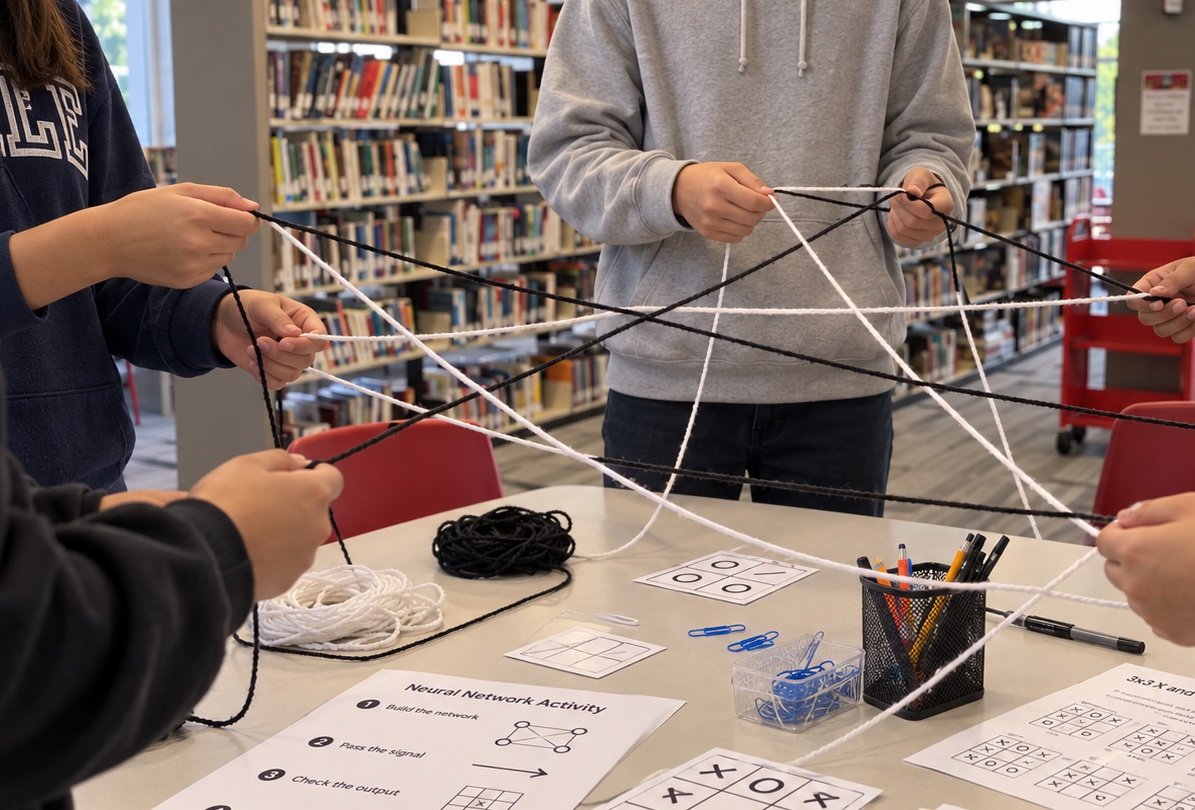
Algorithms, logic, networks, codes and machine learning, acted out with bodies, cards, string and beads. No screens.
Make it real
Kids do learn to code, as one way to express an idea. They also prototype and build physical systems when that's the better tool.
AI comes last
Once they understand training, data and error, they use AI seriously: checking its answers, catching confident nonsense, and knowing when not to use it.
“I don't know yet. Here's what I'll try.”
The aim is confidence facing a problem they've never seen. Success isn't a list of software skills. It's a change in how a kid reacts when the answer isn't obvious.
They don't panic
Not knowing becomes the start of the problem, not the end of it.
They experiment
They test ideas without waiting for perfect instructions.
They ask better questions
They look for assumptions, constraints and missing information.
They want evidence
A confident answer isn't enough. They want to know why to trust it.
They iterate in public
Failure becomes information. They adjust, rebuild and try again.
Same curriculum. Built around your room.
Aligned to CSTA, AI4K12 and ISTE standards. See how a sample lesson maps →
Knowing it isn't enough. Explain it.
To show you progress, a kid has to teach the idea to someone else: a parent, a sibling, a friend, or the camera. If you can explain it clearly, you probably understand it.